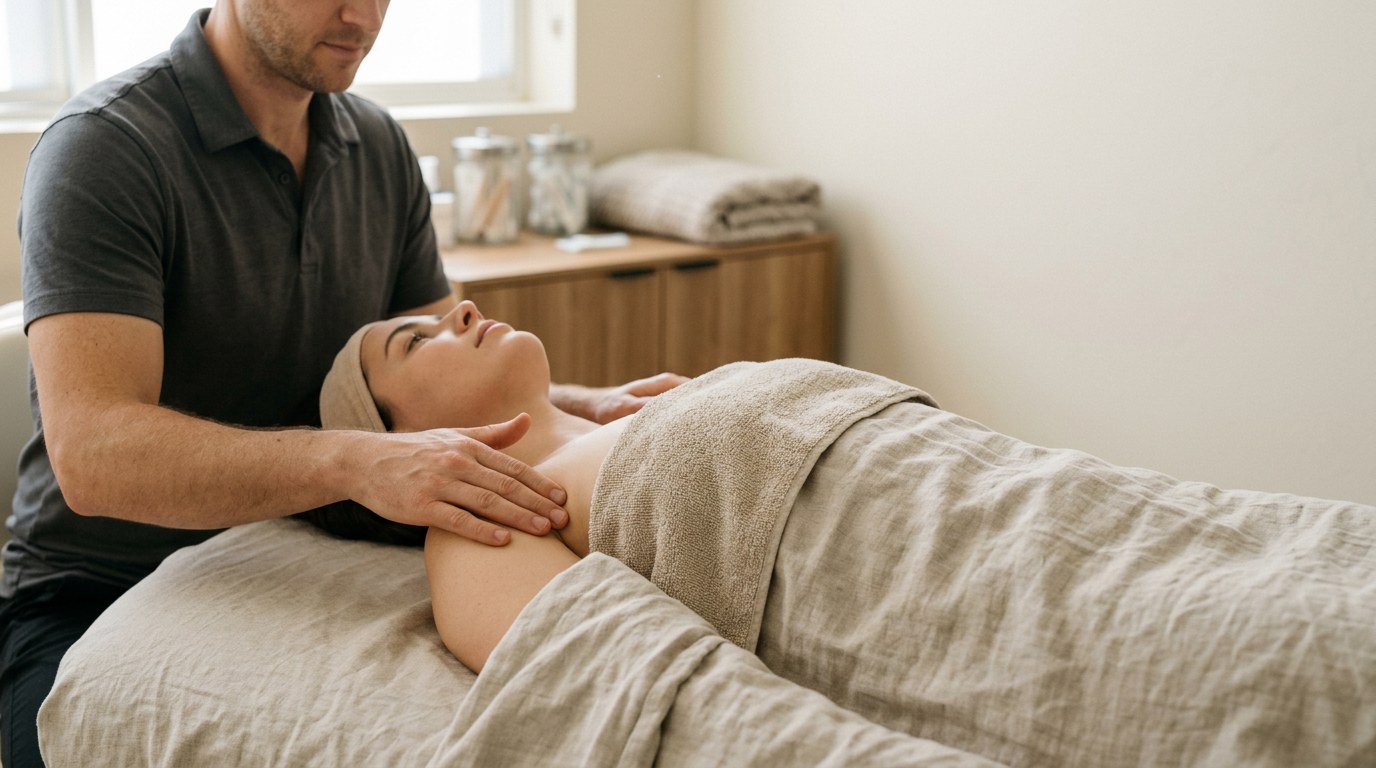
Manual Lymphatic Drainage (MLD) uses very light pressure to help your body move excess fluid out of surgical sites after BBL, liposuction, or tummy tuck. It reduces swelling, lowers the risk of fibrosis, and supports more organized healing. MLD complements your compression garment and surgeon's protocol — it doesn't replace either.
You've had surgery. Maybe a BBL, maybe liposuction, maybe a tummy tuck. Your surgeon told you to find a "lymphatic massage therapist." You searched Salt Lake City, found a lot of conflicting information, and now you're trying to figure out what's real, what's marketing, and who to actually book with.
Here's a clinical perspective from someone who's been doing this work for 20+ years in a real clinical practice in Salt Lake City. The short version: skilled MLD genuinely helps after these procedures. But there's a real gap between what's possible clinically and what some clinics promise. This post covers what MLD does, what it doesn't, when to start by procedure, and how to find someone qualified.
What MLD actually does (and what it doesn't)
Manual Lymphatic Drainage is a specific, trained technique designed to move lymphatic fluid through the lymphatic system more efficiently. It uses very light pressure — far lighter than most people expect from "massage" — and follows specific anatomical pathways toward functioning lymph nodes.
It isn't "draining toxins." That's marketing language, not physiology. What MLD does is help your body move excess fluid — and the protein, cellular debris, and inflammatory byproducts in that fluid — out of swollen tissue and into the bloodstream, where it's filtered and processed normally. After surgery, your lymphatic system is overloaded. MLD helps it catch up.
Why these surgeries especially benefit from MLD
BBL, liposuction, and tummy tucks share something in common: they all create massive, sudden fluid shifts in the body. Lymphatic vessels themselves are disrupted during the procedure — especially with liposuction's cannula work. The tissue is swollen, bruised, and filled with serum, blood, and inflammatory exudate.
Without intervention, that fluid has three places to go: reabsorbed gradually by the lymphatic system (slow — weeks to months); encapsulated as fibrosis (hard lumps under the skin — a common complaint after lipo and BBL); or pooled as seromas (fluid pockets that may need drainage by your surgeon). Skilled MLD helps the first happen faster, reduces the risk of the second, and can sometimes reduce the size and severity of the third.
When to start, by procedure
The right time to start MLD depends on which surgery you had. Generic protocols don't apply equally — each procedure has its own healing rhythm and its own risks. Your surgeon's specific instructions always take precedence over the general guidance below.
- Liposuction — Most surgeons clear MLD 24–72 hours post-op, once the worst of the immediate swelling and bruising has stabilized. Typically 5–10 sessions over 4–6 weeks, more frequent in the first two weeks. Standard positioning, with gentle work around cannula entry points.
- BBL — Usually within the first week post-op. Typically 6–12 sessions over 4–8 weeks. Positioning is the key challenge: side-lying, prone, or seated only — no lying on your back until your surgeon clears it, since pressure on the grafted fat can compromise survival.
- Tummy tuck (abdominoplasty) — Wait until drains are out and the incision is sealed, typically 10–14+ days. Typically 4–8 sessions over 6–10 weeks, with modified positioning to protect the abdominal incision and any binders.
Source: combined guidance from Dr. Vodder Academy International protocols and the American Society of Plastic Surgeons (ASPS) post-operative recovery recommendations. Your surgeon's specific instructions always override generic timelines.
What MLD won't do — honest limitations
This is the part most clinics don't tell you.
- MLD will not shape your results. The contour you see after surgery is determined by what your surgeon did and how your tissue heals — not by how many MLD sessions you book.
- MLD will not replace your compression garment. Compression is doing most of the work; MLD complements it.
- MLD will not drain a hematoma or a meaningful seroma. Those require your surgeon's attention, not more massage.
- MLD will not prevent every case of fibrosis. It reduces the risk and severity, but it isn't a guarantee.
After BBL, lipo, or a tummy tuck, your lymphatic system is overloaded. Skilled MLD helps it catch up — reducing the risk of fibrosis, the firm lumps that form when fluid encapsulates instead of clearing.
What a session looks like in my Salt Lake City practice
A post-op MLD session here is unhurried, clinical, and centered on your specific surgery and stage of healing. Sessions run 60 to 90 minutes. We start with intake — what you had done, when, what your surgeon's instructions are, what your compression schedule is, and how you're feeling that day. The technique itself is light — if it hurts or feels aggressive, it isn't MLD. Most clients describe sessions as deeply calming; many fall asleep.
Practice is at Flow Acupuncture in Salt Lake City's Historic University District, by appointment only.
Red flags — when to call your surgeon, not your MLD therapist
Call your surgeon (not me) if any of these appear: sudden increase in swelling, pain, or redness in one limb, especially the calf (possible DVT); pus, foul odor, or expanding redness around an incision (possible infection); fever above 101°F; a growing fluid pocket that feels like a water balloon under the skin (possible seroma needing surgical drainage); or new shortness of breath or chest pain (call 911). MLD therapists are part of your post-surgical care team — but we are not your surgeon. Any complication needs to go to them first.
How to find a qualified MLD therapist
Not every massage therapist who advertises "lymphatic drainage" is trained in it. MLD is a specific certification, and the four widely recognized clinical lineages — Dr. Vodder (Austria, 1932, the original and most widely recognized), Földi (Germany, strong emphasis on lymphedema and post-surgical fibrosis), Casley-Smith (Australia, research-based), and Klose Training (U.S.-based adaptation of the Földi protocol) — each require 90+ hours of dedicated training. Ask before booking; a real MLD therapist will tell you exactly where they trained and how many hours.
You also want someone who has worked with post-surgical patients specifically, and who paces sessions with clinical intent rather than volume. If a clinic is selling you a "package" of ten sessions over four days with three different therapists, that's a volume operation, not clinical care.
If you're in Salt Lake City and recovering from cosmetic surgery
I'd be glad to talk through your timeline and protocol. Sessions are at Flow Acupuncture in the Historic University District, by appointment only — twenty-plus years of clinical experience, including significant work with post-surgical patients.
Bryan Lindquist, LMT is a clinical massage therapist practicing in Salt Lake City at Flow Acupuncture (1204 E South Temple) and at Huntsman Cancer Institute's Wellness & Integrative Health Center.
Frequently Asked Questions
How soon after surgery can I start MLD?
It depends on your procedure. Liposuction patients often start 24–72 hours post-op. BBL patients usually start in the first week with adapted positioning. Tummy tuck patients typically wait 10–14+ days, until drains are out. Your surgeon's clearance is always the deciding factor.
How many MLD sessions do I need?
Most post-surgical clients book 5–10 sessions over the first 4–8 weeks. Lipo and BBL recoveries lean to the higher end of that range; tummy tucks often need fewer, since MLD starts later in the healing arc.
Will MLD hurt?
No. MLD uses very light pressure — far lighter than people expect from massage. If it hurts or feels aggressive, it isn't MLD as a trained therapist would deliver it.
Can MLD help if I already have fibrosis?
MLD is more effective at preventing fibrosis than reversing it. Once tissue has hardened into established fibrosis, deeper manual techniques become the primary tools, with MLD playing a supporting role in clearing residual fluid around fibrotic areas.
Do I need a referral from my surgeon?
Not legally, but for tummy tucks especially, a written clearance from your surgeon is strongly recommended. For lipo and BBL, a verbal go-ahead is usually sufficient.
Recovering from cosmetic surgery?
Gentle, clinically grounded lymphatic care in Salt Lake City. New clients welcome.
Book a Recovery Session